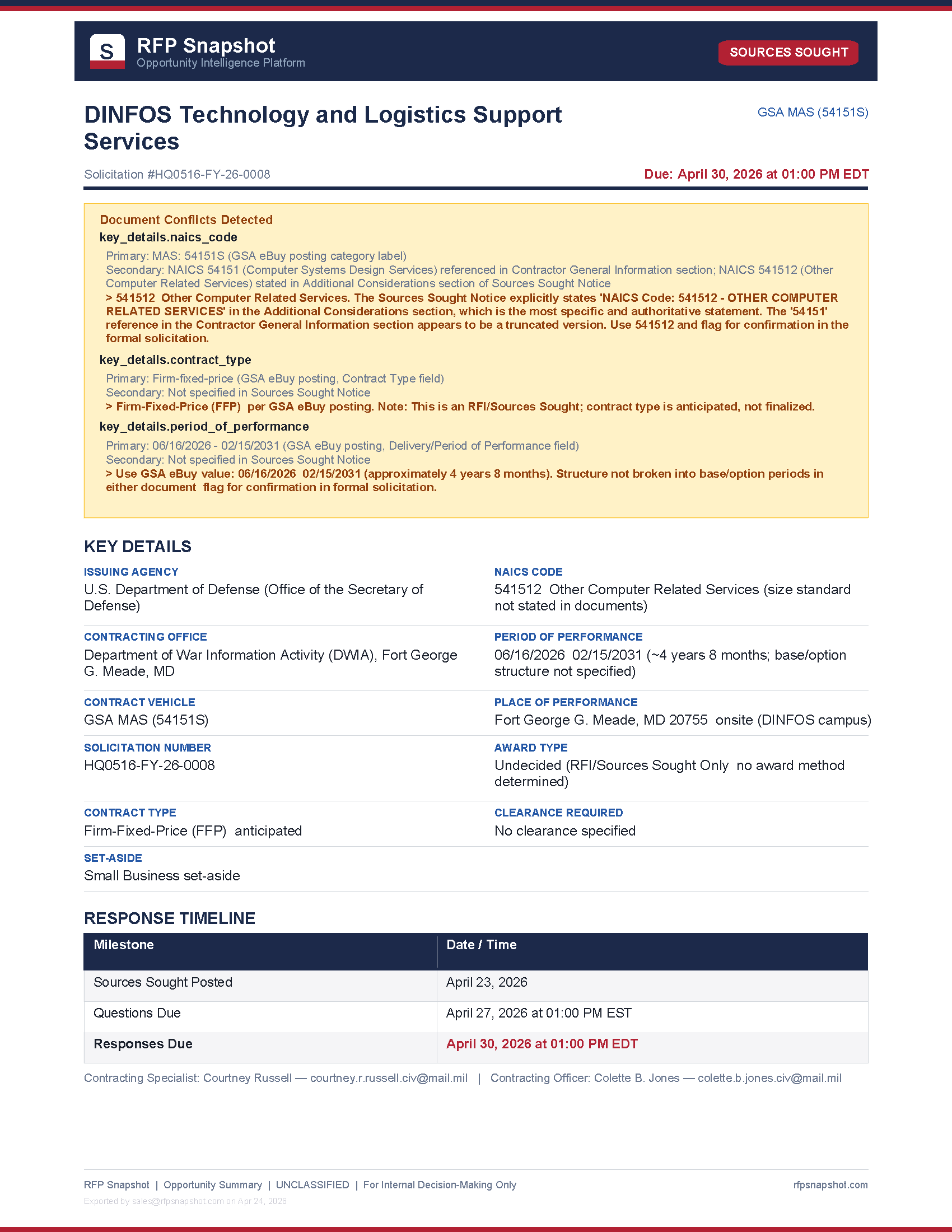
Slower week for full RFPs, but two GSA MAS SIN 54151S RFIs landed on eBuy that small businesses on schedule should not let pass. The Department of War Information School (DINFOS) posted HQ0516-FY-26-0008 on April 23 — a small business set-aside covering IT, audio/visual, and logistics support across the Fort Meade campus. The U.S. Agency for Global Media (USAGM) is running RFI1807864 in parallel, seeking input on a 6-FTE onsite enterprise sysadmin requirement at headquarters in Washington, DC.
Both are early-stage market research notices, both flow through GSA MAS 54151S (IT Professional Services), and both have response windows that close inside the next two weeks. Here's what each requirement actually asks for, and why they're worth the response effort even at the RFI stage.
DINFOS: a multi-discipline campus support contract
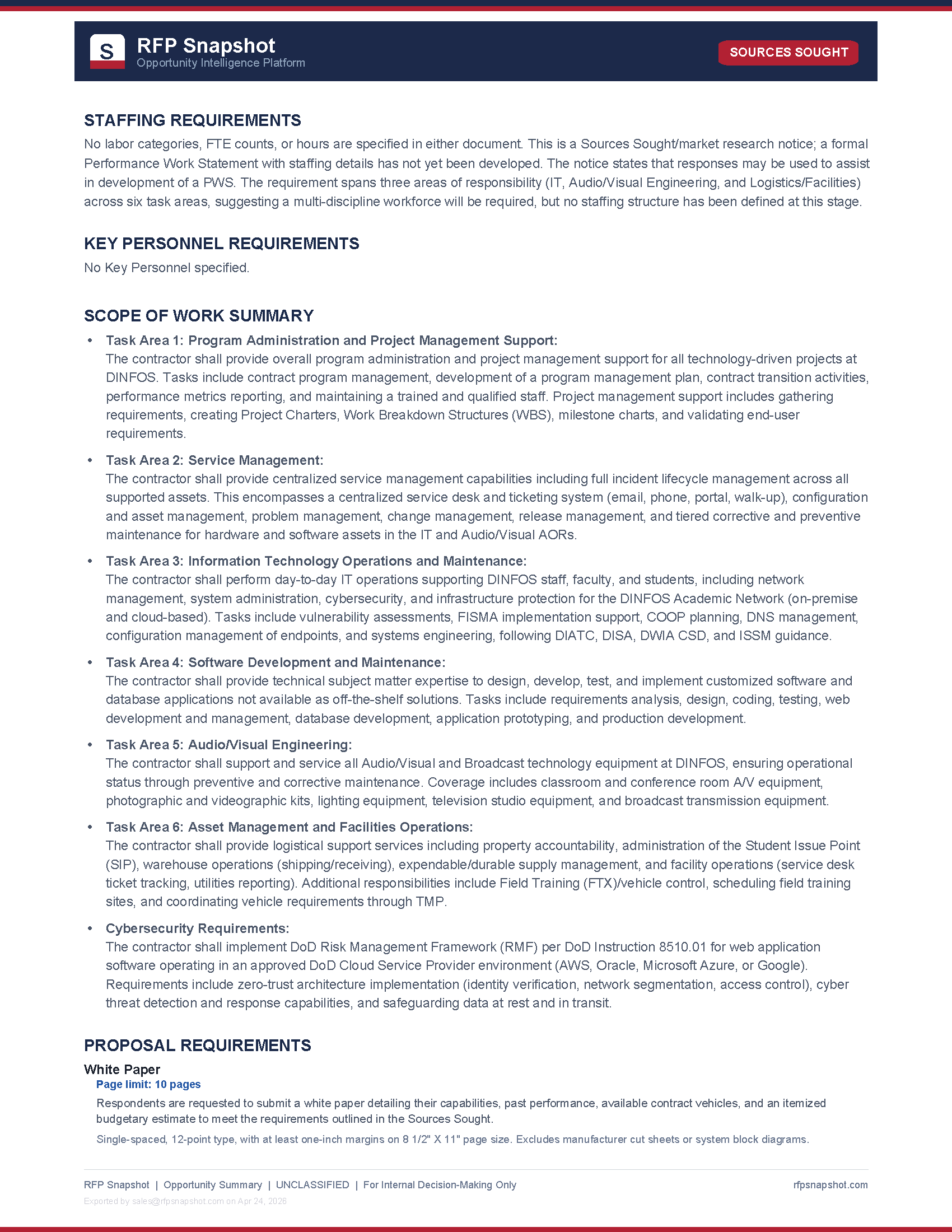
The DINFOS requirement is broader than its 54151S category label suggests. The Department of War Information Activity is gathering information on a single bundled contract covering three distinct areas of responsibility: IT operations, audio/visual engineering, and logistics/facilities. The Sources Sought outlines six task areas — program management, service management, IT operations and maintenance, software development, audio/visual engineering, and asset management/facilities operations.
The IT scope is conventional federal IT shop work: service desk and ticketing, network management, system administration, RMF/FISMA implementation, vulnerability management, COOP planning, DNS, and endpoint configuration management — all aligned to DIATC, DISA, and DWIA CSD guidance. What sets this requirement apart is the Google environment requirement. The Sources Sought explicitly states the vendor must support and operate in a Google environment, which is a meaningful constraint given how much DoD IT work assumes Microsoft 365 or AWS GovCloud as the baseline. Teams should plan for Google Workspace and Google Cloud expertise, not just translate Microsoft credentials.
The audio/visual scope covers classroom and conference room A/V, photographic and videographic kits, lighting, television studio equipment, and broadcast transmission gear. This is genuine broadcast/instructional media work — DINFOS trains military journalists, broadcasters, and public affairs personnel — not generic conference room support. The logistics scope covers Student Issue Point administration, warehouse operations, supply management, facility service desk coordination, FTX/vehicle control, and TMP scheduling.
The cybersecurity overlay requires DoD RMF implementation per DoDI 8510.01, zero-trust architecture, and operation in an approved DoD Cloud Service Provider environment (AWS, Oracle, Azure, or Google).
What's missing from the DINFOS RFI — and why it matters
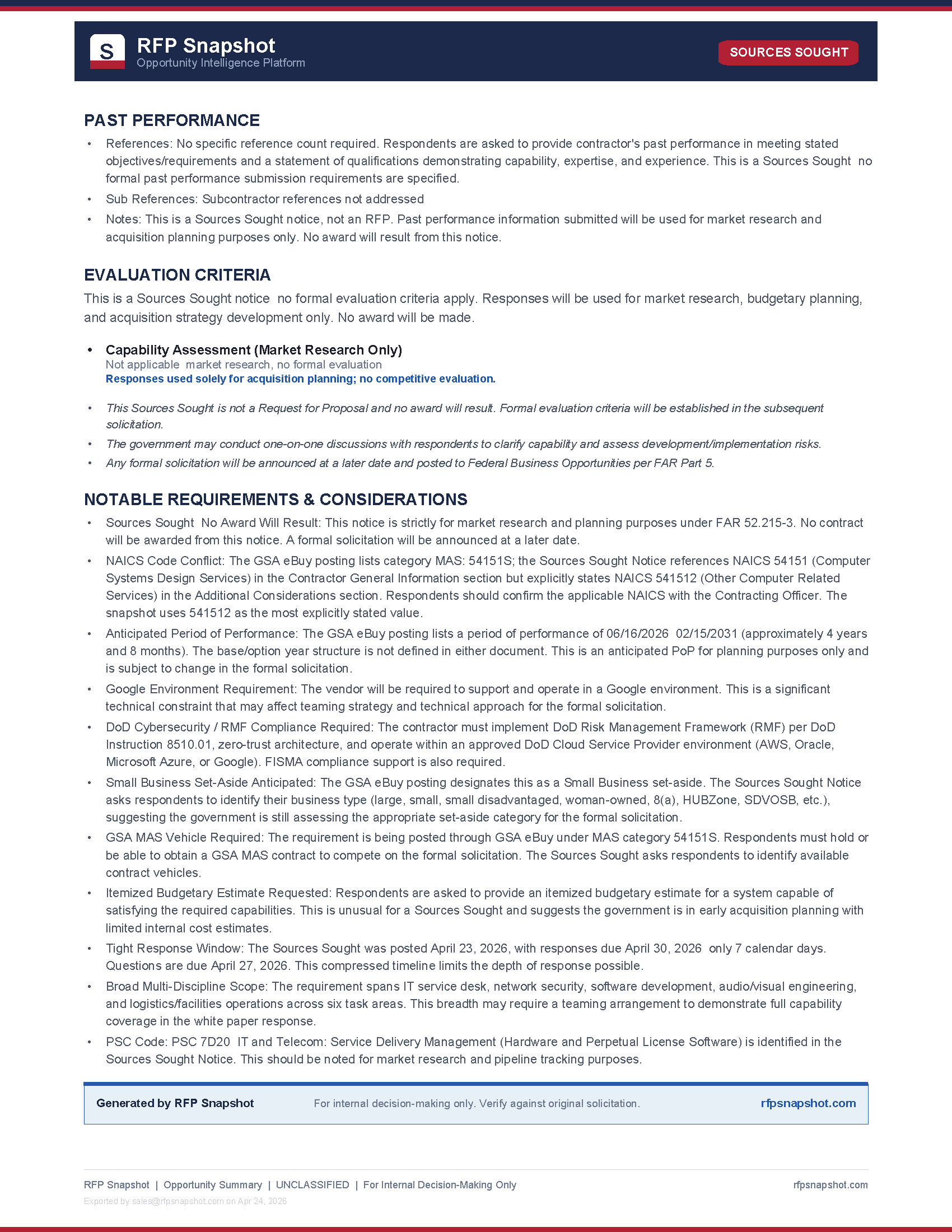
The DINFOS Sources Sought does not specify labor categories, FTE counts, or hours. There's no Performance Work Statement yet. The notice explicitly states responses may be used to develop the PWS, salient characteristics, and performance specifications — meaning early RFI respondents have a real opportunity to shape the eventual solicitation rather than simply react to it.
The notice also asks for an itemized budgetary estimate, which is unusual for a Sources Sought and signals the government has limited internal cost data for this consolidated bundle. Respondents who can credibly show a labor mix and ROM across all six task areas have a chance to anchor the government's expectations before the formal solicitation drops.
One other detail worth flagging: there's a NAICS conflict in the DINFOS documents. The Contractor General Information section references 54151 (Computer Systems Design Services), but the Additional Considerations section explicitly states 541512 (Other Computer Related Services). The eBuy posting uses MAS category 54151S. Confirm the operative NAICS in the Q&A — it affects size standard analysis and teaming decisions.
USAGM: a tightly scoped 6-FTE enterprise sysadmin bundle
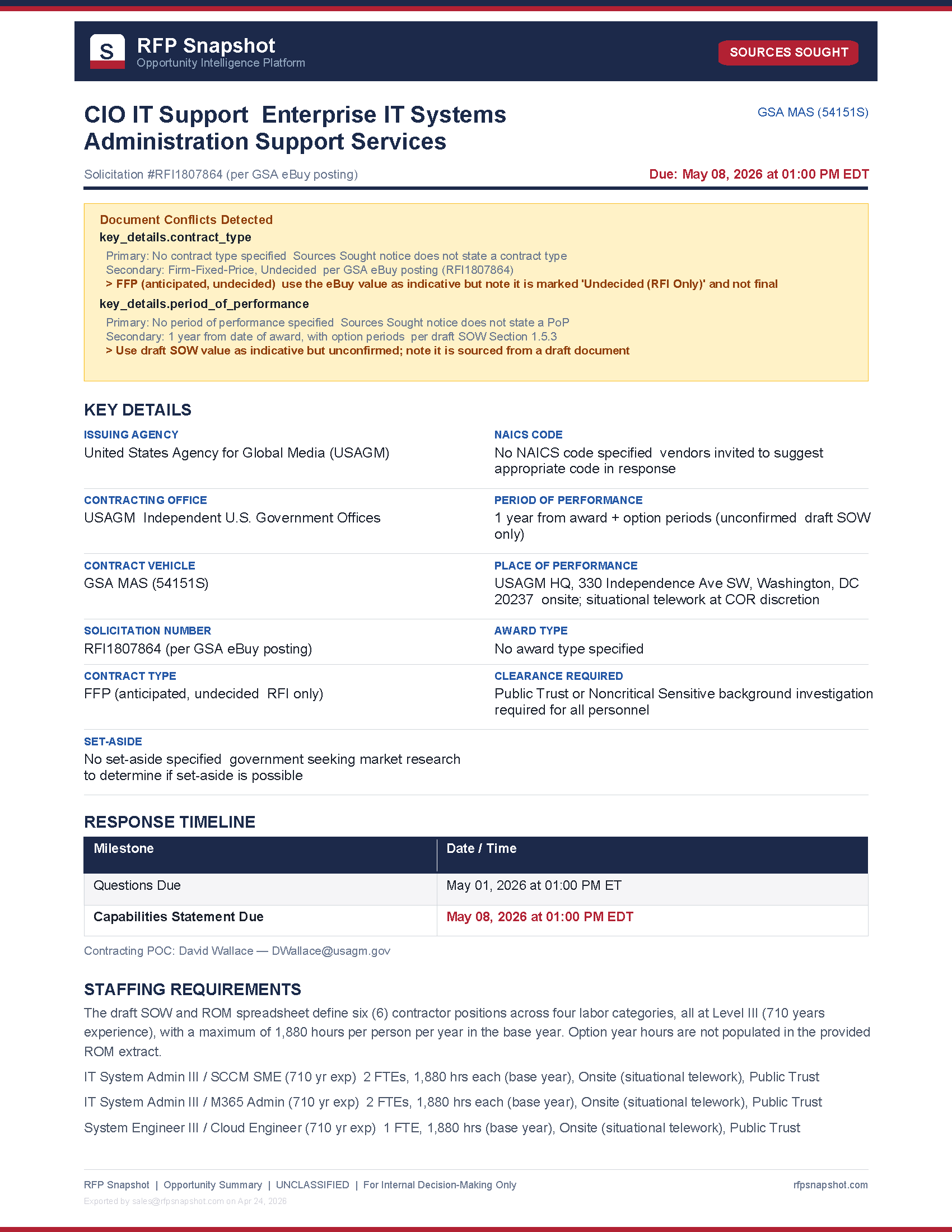
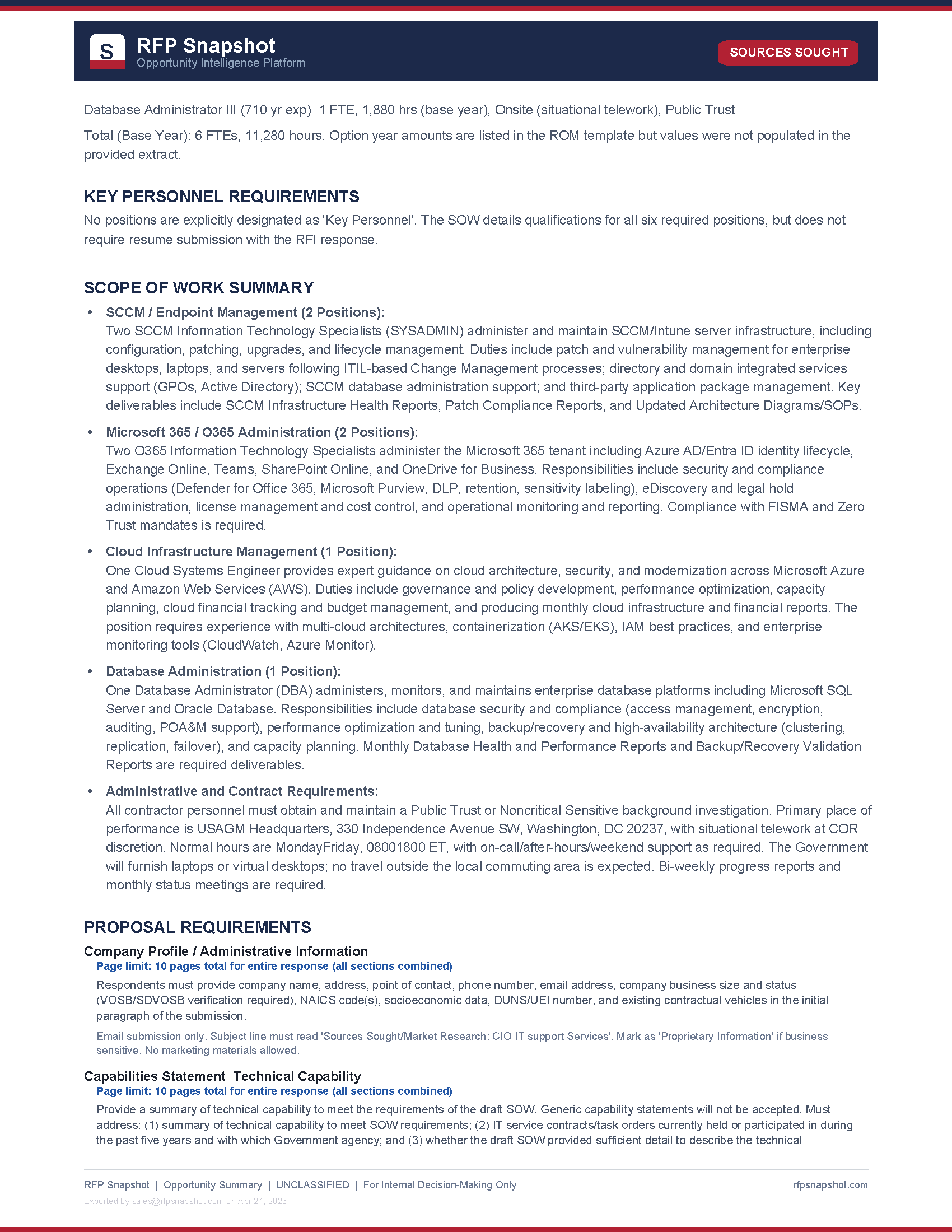
The USAGM requirement is the opposite of the DINFOS bundle: narrow, well-defined, and built around six specific positions across four labor categories. The draft SOW spells out two SCCM/Endpoint Information Technology Specialists, two O365/Microsoft 365 Information Technology Specialists, one Cloud Systems Engineer (Azure + AWS), and one Database Administrator (SQL Server + Oracle). All six positions are scoped at 7–10 years of direct experience and 1,880 hours per FTE in the base year — 11,280 total base-year hours across the team.
The work supports USAGM's enterprise platforms and storage organization across the agency's broadcasting networks (VOA, OCB, RFE/RL, RFA, MBN, OTF). Scope is conventional Microsoft enterprise work: SCCM/Intune endpoint management, M365 tenant administration with Defender and Purview, multi-cloud governance, and database administration with backup/recovery and high availability.
The constraints that will shape the bid are the easy ones to miss. Public Trust or Noncritical Sensitive background investigation is required for all personnel — not Secret, not TS — which keeps the labor pool wider but still rules out anyone with disqualifying background issues. Performance is primarily onsite at 330 Independence Avenue SW, with situational telework only at COR discretion. This is not a remote or hybrid contract. Normal hours are 0800–1800 ET with on-call, after-hours, and weekend support required.
Personnel replacement timelines run 45 calendar days for departing staff. The government furnishes laptops or virtual desktops, so no contractor-owned IT spend is anticipated.
What's actually being asked for in the USAGM response
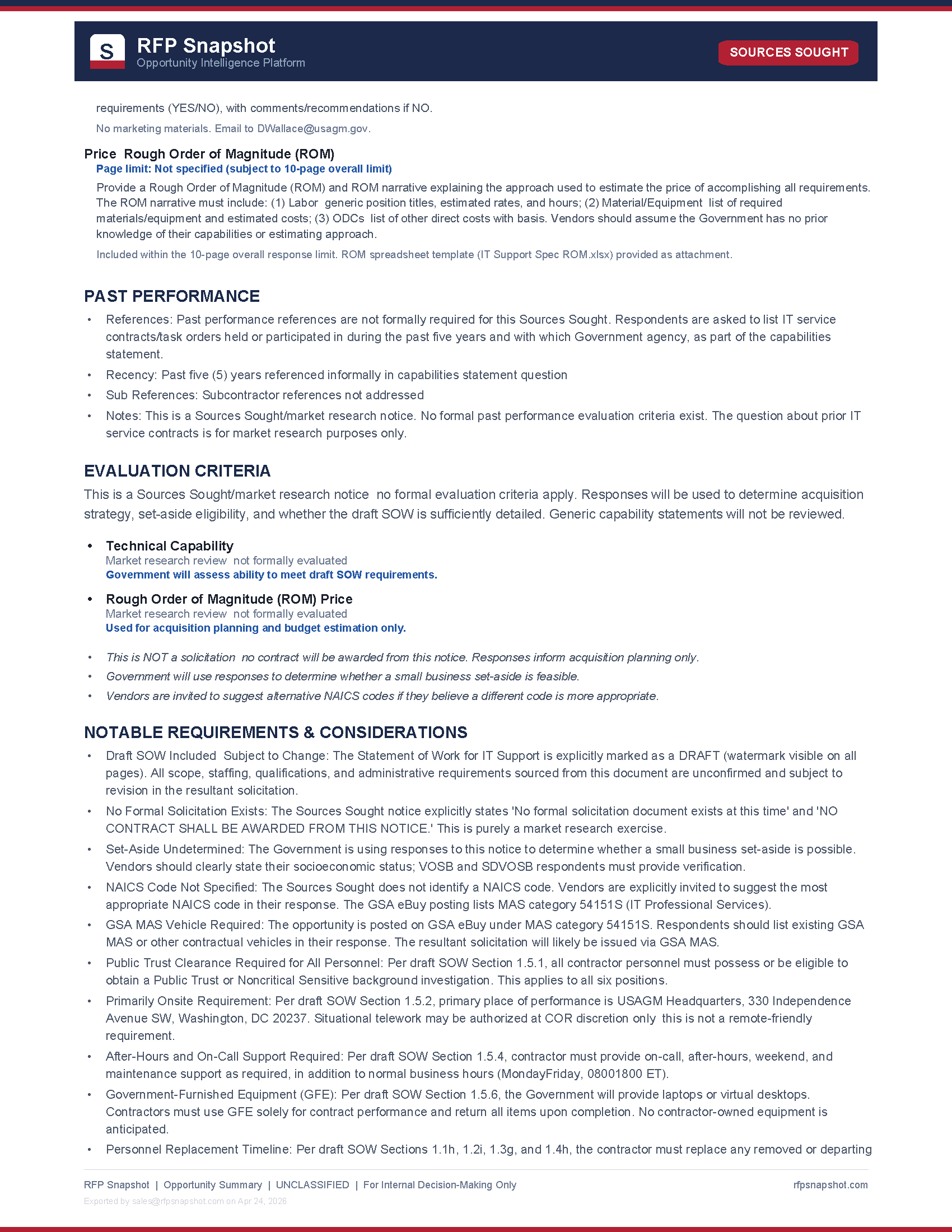
The USAGM Sources Sought is a 10-page total cap covering company profile, technical capability, and ROM — in a single document. No marketing materials are accepted. The technical section needs to address the draft SOW directly (generic capability statements will not be reviewed), list IT service contracts held or participated in over the past five years with the contracting agency, and answer YES/NO whether the draft SOW provides sufficient detail to describe the technical requirements.
The price ROM piece is the part most respondents will under-invest in. The notice specifies an Excel template (IT Support Spec ROM.xlsx) with the six positions and 1,880 hours per FTE in the base year. The narrative needs to walk the government through the labor basis (generic position titles, rates, hours), materials/equipment, and ODCs as if they know nothing about your firm — because for market research purposes, they don't. Option year hours are not populated in the template extract; respondents should clarify whether option year ROM detail is expected.
USAGM is also explicitly asking respondents to suggest the most appropriate NAICS code, since none was specified in the Sources Sought itself. This is the right place to flag whether 541512, 541513, or 541519 better fits the work — and to make the case for whether a small business set-aside is feasible based on industry capacity.
Why both RFIs are worth the response effort
The instinct on RFIs is to triage them as no-bid because nothing's being awarded. That's usually right. These two are the exception for small businesses on GSA MAS 54151S for three reasons.
First, both are early enough to shape the eventual solicitation. DINFOS doesn't have a PWS yet. USAGM's set-aside determination is undetermined and depends on what small businesses respond. Vendors who file substantive responses — not boilerplate — get to influence labor categories, evaluation criteria, and set-aside decisions before the competition starts.
Second, incumbent intelligence is limited for both. USAGM's draft SOW is brand new and references no incumbent contract. DINFOS hasn't disclosed an incumbent in the Sources Sought. That means the playing field is more open than a typical recompete, and BD teams who do their own incumbent research now will have a head start when the formal solicitation drops.
Third, the response cost is bounded. USAGM is 10 pages with a defined ROM template. DINFOS is 10 pages of white paper on 8.5x11 with one-inch margins. Neither requires resumes, past performance volumes, or pricing detail at the level of a full proposal. A focused response from a qualified team is a 1–2 day effort, not a 2–3 week proposal cycle.
Timeline and what to do this week
DINFOS questions are due April 27 at 1:00 PM EST; responses are due April 30 at 1:00 PM EST. USAGM questions are due May 1 at 1:00 PM ET; responses are due May 8 at 1:00 PM EDT. Both response windows are tight by RFI standards (7 calendar days for DINFOS, ~15 for USAGM), so capture and proposal teams need to make the bid/no-bid call inside the next 48 hours to leave time for a substantive response.
For DINFOS: confirm Google environment expertise on the team (or via a sub), validate ability to cover all six task areas, and prepare an itemized budgetary ROM that covers IT, A/V, and logistics. For USAGM: confirm Public Trust eligibility for all proposed personnel, build the ROM in the supplied Excel template, and answer the YES/NO sufficiency question on the draft SOW with substantive recommendations if the answer is no.
Both opportunities favor small businesses with existing GSA MAS 54151S vehicles, federal IT past performance in the past five years, and the bench depth to staff onsite within the geography. Neither is a high-margin opportunity in isolation — both are exactly the kind of foundational work that anchors a 54151S small business pipeline through 2031.