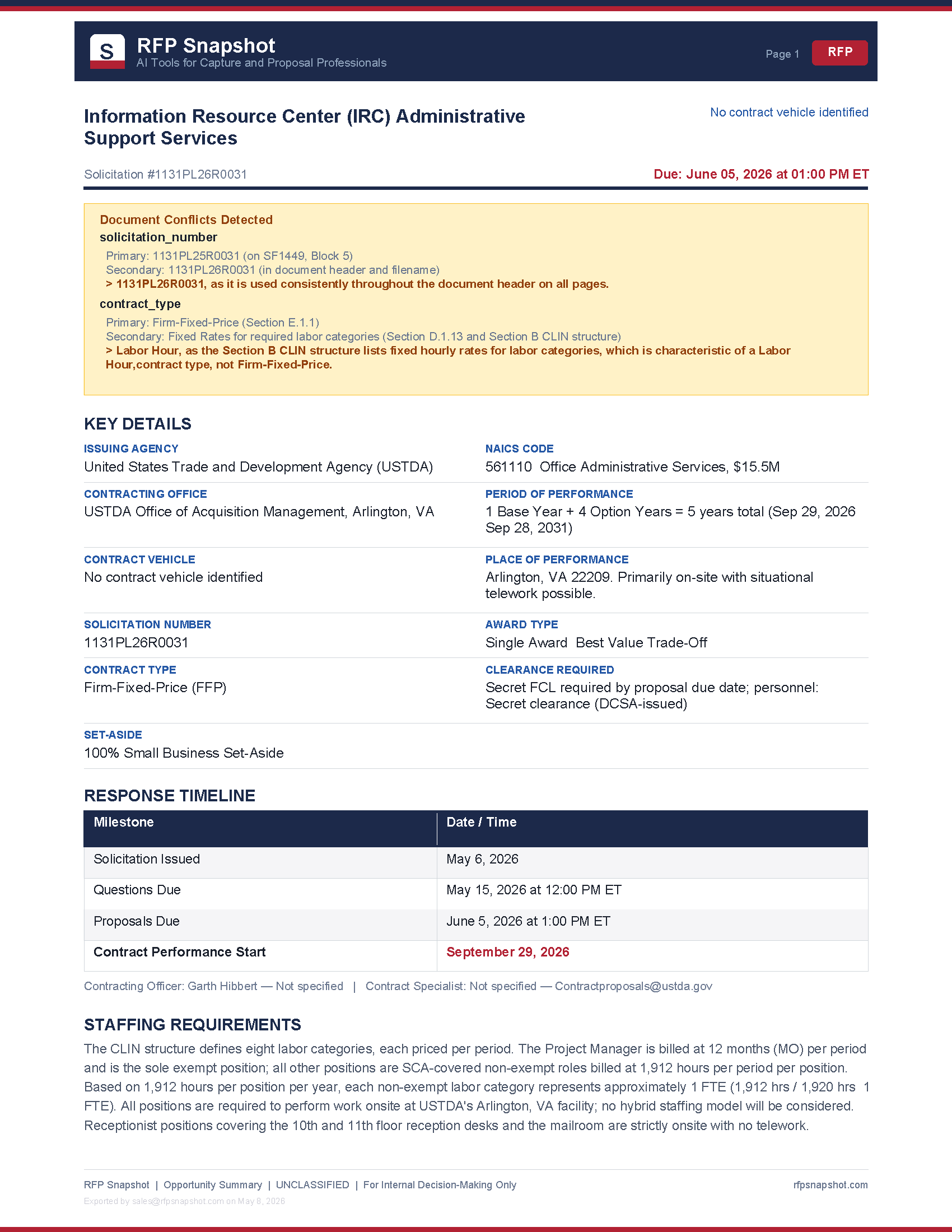
The U.S. Trade and Development Agency dropped solicitation 1131PL26R0031 on May 6, 2026 — a recompete of its Information Resource Center Administrative Support Services contract, currently held by IT Shows, Inc. under contract 1131PL20CSA41021. The requirement is 100% set aside for Small Business. Proposals are due June 5, 2026 at 1:00 PM ET. Questions must be in by May 15.
This is the kind of opportunity that reads small on the surface — eight FTEs, an administrative scope, a $12.5M NAICS size standard — and is unforgiving in the details. There's a hard Secret facility clearance gate on the proposal due date. There's a 15-year incumbent on one of the seven non-exempt SCA positions. There's an OCI clause that bars the awardee from competing on USTDA program work for five years. And there's a solicitation number discrepancy on the SF 1449 itself. None of this is hidden, but none of it is obvious from a casual read.
What USTDA actually does — and why this contract exists
The U.S. Trade and Development Agency funds the upfront technical work that helps overseas infrastructure projects attract financing. Feasibility studies, front-end engineering and design, technical assistance, pilot projects — the kinds of activities that come before a project is bankable. The agency is small by federal standards, headquartered in a single building at 1101 Wilson Boulevard in Arlington, and runs a tightly defined administrative footprint.
That footprint is what this contract supports. The Information Resource Center is USTDA's records management, FOIA, mail, reception, conference room, and general administrative function rolled into one. The contractor manages the agency's Central Agency Files, serves as the primary point of contact with NARA, runs the FOIA intake and response process, staffs two reception desks (10th and 11th floor), supports 50 to 60 events per year in seven conference rooms and a Business Center training facility, runs the mail room, and maintains the IRC Manual, Correspondence Procedures Manual, and Administrative Manual. It is broad, repeatable, onsite, and continuous.
The eight-position staffing plan, in plain terms
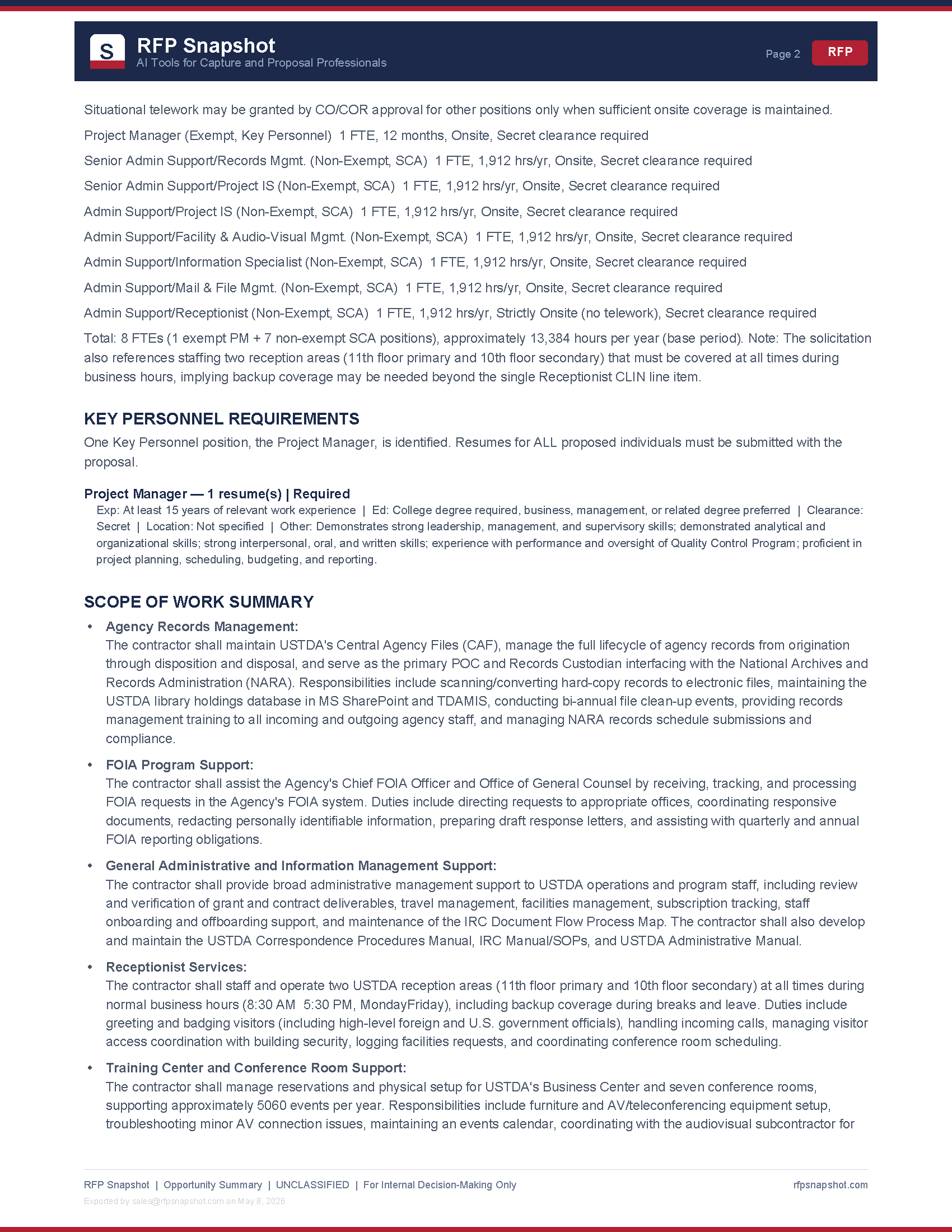
The CLIN structure prices eight labor categories per period. The Project Manager is exempt and billed at 12 months per year; the other seven positions are SCA-covered and billed at 1,912 hours each per year. That's roughly 13,384 labor hours per year, or eight FTEs — and the wage determination is WD 2015-4281, Revision 36, covering Fairfax, Fauquier, Loudoun, Prince William, and Stafford counties.
The Statement of Equivalent Rates for Federal Hires (FAR 52.222-42) tells you exactly how the government values each position internally. The two Senior Admin Support roles map to GS-12 equivalents. The two Admin Support/Project IS positions map to GS-11. The Information Specialist maps to GS-9. The Mail & File Management and Receptionist roles map to GS-7. None of this is a wage requirement, but it's a useful sanity check on whether your loaded rates are landing in the right zone for SCA compliance and price realism.
The strictly onsite requirement is unusually firm. The solicitation explicitly says "no proposed hybrid staffing model (onsite and telework) will be considered." The receptionist positions covering the 10th and 11th floor desks and the mailroom have zero telework, period. Situational telework for other positions requires CO/COR approval and adequate onsite coverage. If your pricing or staffing approach assumes any baseline telework, it's non-compliant.
One Key Personnel position — but resumes for everyone
The only formally designated Key Personnel role is the Project Manager: 15 years of relevant experience, a degree (business or management preferred), Secret clearance, and demonstrated experience running quality control programs. Standard for a contract of this scope.
What is not standard: USTDA requires names and resumes for ALL proposed individuals as part of the proposal — not just key personnel. Resumes for non-incumbent staff must include points of contact (names, phone numbers, emails) for relevant projects. The Offeror or Offeror personnel cannot be submitted as the point of contact. A written certification that each Key Personnel candidate was contacted after the solicitation issue date and confirmed availability is also required.
For a non-incumbent, this is a recruiting problem before it's a proposal problem. You need eight named, cleared (or clearable), available candidates — with verifiable references — ready to be locked in by June 5. Backfilling that pipeline from cold in four weeks is not realistic without a structured process. RFP Snapshot's Recruiter Accelerator generates ready-to-post job descriptions and Boolean search strings (Indeed, LinkedIn, ClearanceJobs, Google) for every position in the PWS the same day the snapshot lands — which on this opportunity is the single biggest determinant of whether you can credibly bid.
The Secret FCL gate — this is the first decision you need to make
USTDA states it plainly: the prime contractor must hold, at minimum, an interim Secret facility clearance granted by DCSA on the RFP closing date. USTDA will not serve as a facility clearance sponsor. If your firm doesn't have an FCL today, you are ineligible to compete as a prime — full stop. Sponsorship is a months-long process, not a four-week one.
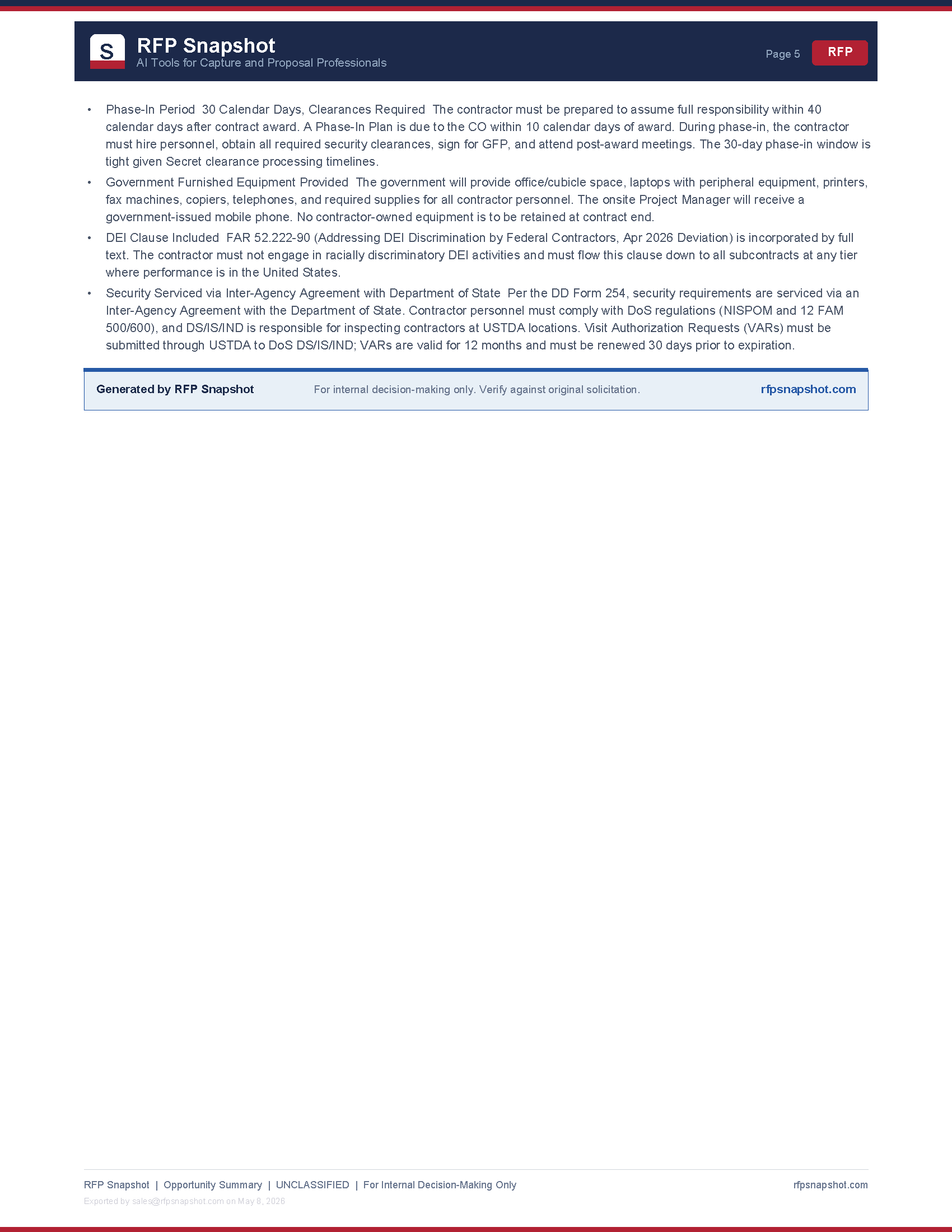
This requirement is paired with a parallel personnel requirement: every contractor employee on this contract must possess a Secret clearance prior to assignment. Uncleared personnel can perform temporarily with CO discretion, pending issuance, but must hold a Department of State Personal ID Facility Access Card (FAC) before performance. Classified storage at the contractor facility is not authorized; security is administered through an Inter-Agency Agreement with the Department of State, which means Visit Authorization Requests flow through USTDA to DoS DS/IS/IND.
If you don't have an active FCL and Secret-cleared bench, the bid/no-bid decision is essentially made for you. If you do, your differentiator on this opportunity is whether you can execute the 30-day phase-in cleanly — which is the next consideration.
The 15-year incumbent and the SCA right-of-first-refusal math
The solicitation names the incumbent (IT Shows, Inc.) and lists the tenure of every non-exempt SCA position currently performing the work:
- Senior Admin Support/Records Mgmt. — 1 year tenure
- Senior Admin Support/Project IS — 15 years tenure
- Admin Support/Project IS — 3 years tenure
- Admin Support/Facility & Audio-Visual Mgmt. — 8 years tenure
- Admin Support/Information Specialist — 2 years tenure
- Admin Support/Mail & File Mgmt. — 3 years tenure
- Admin Support/Receptionist — 1 year tenure
The total incumbent contract value is $4.39M across the base and four option years. There are no vacant positions. This is a lift-and-shift opportunity for any successor, and the SCA right-of-first-refusal under Executive Order 13495 (where applicable) means most of these incumbents will be on the table.
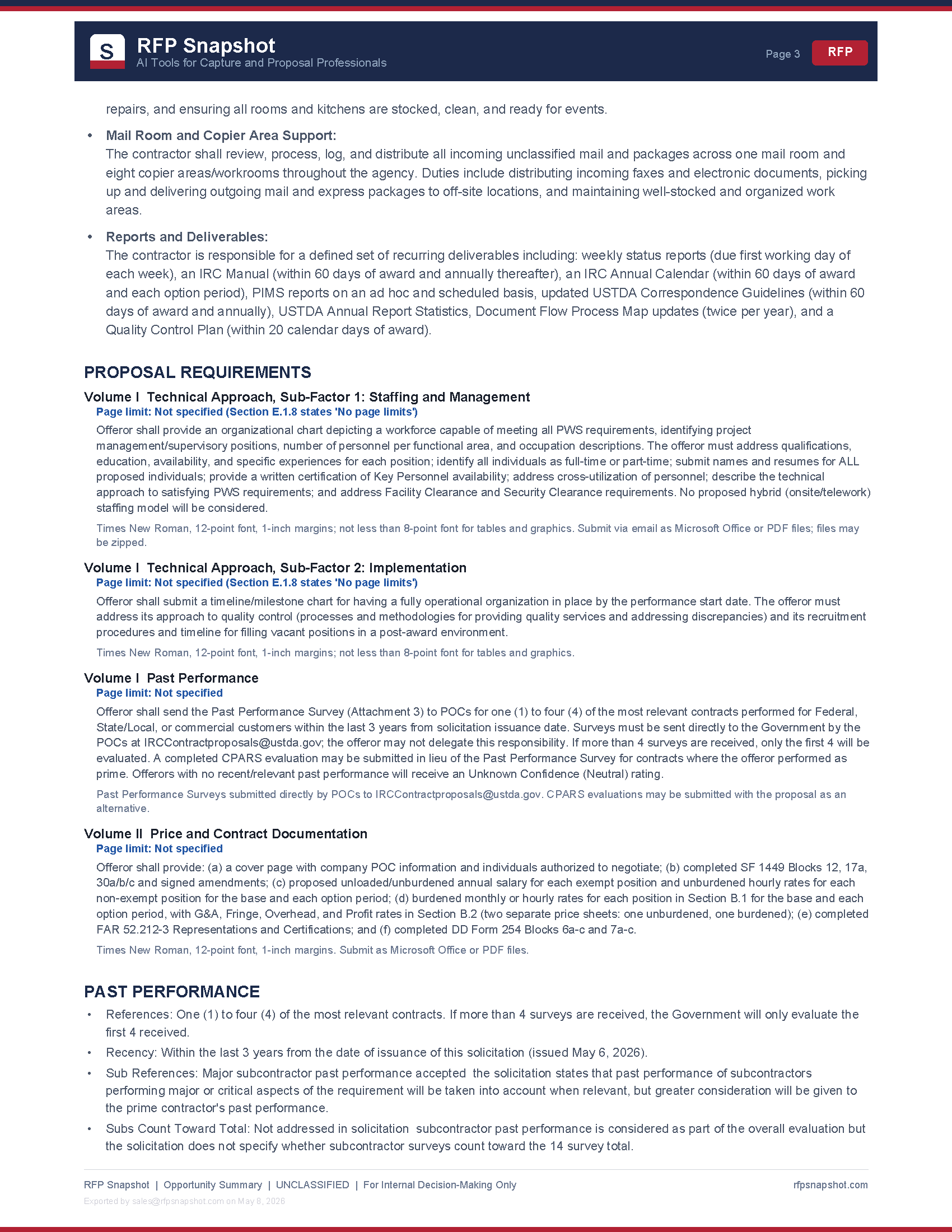
The 15-year tenure on the Senior Admin Support/Project IS position is the most consequential data point in the solicitation. That individual is the institutional memory of the IRC. Their fully-loaded cost is almost certainly above what a clean-sheet wage determination calculation would produce. Your pricing model needs to reckon with two scenarios: you retain the incumbent (real, SCA-compliant, but expensive), or you assume turnover (cheaper on paper but introduces phase-in risk on a 30-day clock that has zero margin for clearance reciprocity issues).
How proposals are evaluated
The award is a single contract under Best Value Source Selection. Three factors:
- Factor 1: Technical Approach — sub-factors Staffing & Management and Implementation. Adjectival ratings (Outstanding, Good, Acceptable, Marginal, Unacceptable).
- Factor 2: Past Performance — Confidence Assessment (Substantial, Satisfactory, Limited, No, Unknown).
- Factor 3: Price — not adjectivally rated; evaluated for completeness and reasonableness.
Technical Approach and Past Performance are of equal importance. Combined, they are significantly more important than Price. The Government intends to award without discussions, so your first submission needs to be your best submission.
Past performance is sourced through Attachment 3, the Past Performance Survey. Surveys go from your POCs directly to the Government at [email protected] — you cannot delegate this. One to four references, performed within the last three years from the May 6, 2026 issuance date. If more than four come in, only the first four are evaluated. CPARS evaluations may be submitted in lieu of the survey for prime work. Offerors with no recent and relevant past performance receive an Unknown Confidence (Neutral) rating.
There are no page limits on Volume I, and the format is Times New Roman 12-point, 1-inch margins, 8-point minimum for tables and graphics. Submission is by email to [email protected] — Microsoft Office or PDF, may be zipped.
Five things buried in the solicitation worth flagging
The solicitation number on the SF 1449 is wrong. Block 5 of the SF 1449 and Block C of the DD Form 254 print "1131PL25R0031," while the document header on every body page reads "1131PL26R0031." The body number is the right one — that's confirmed by the page header, the filename, and the SAM.gov posting — but offerors should reference 1131PL26R0031 in their cover letter and confirm with the Contracting Officer at the question deadline. This is the kind of thing a snapshot catches that a fast read does not.
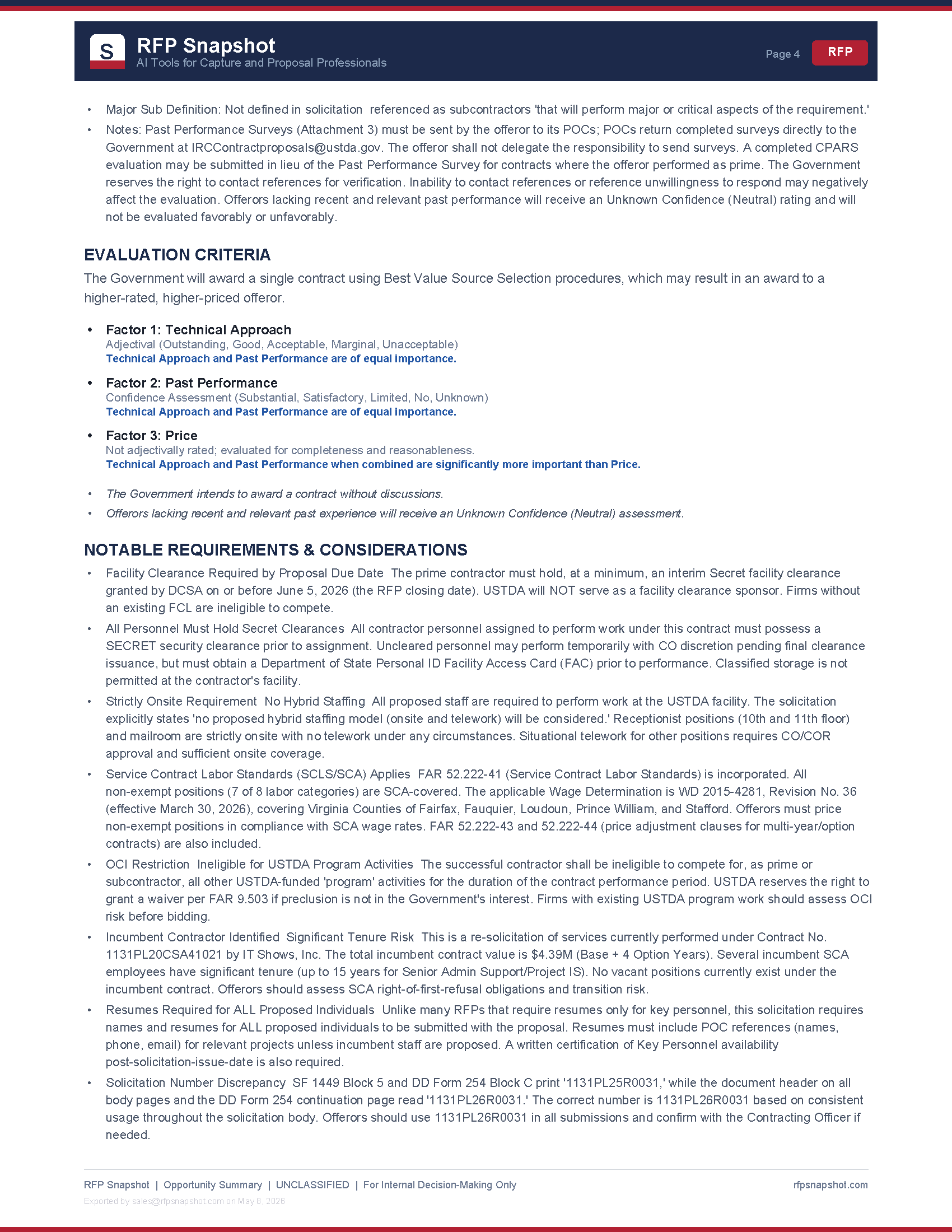
The OCI restriction is broader than you might assume. The successful contractor is ineligible to compete for — as prime, subcontractor, or otherwise — all other USTDA-funded program activities for the duration of contract performance. USTDA can grant a waiver under FAR 9.503 if preclusion is not in the Government's interest, but you should not bid on this assuming the waiver. If your firm has any current or pipeline USTDA program work (feasibility studies, technical assistance grants, FEED studies), assess the OCI exposure before pursuing.
The phase-in is 30 days, with the Phase-In Plan due 10 days after award. During phase-in, the contractor must hire personnel, obtain all required Secret clearances, sign for GFP, and attend post-award meetings. Full operational responsibility transfers within 40 calendar days of award. On a contract where every staff member must hold a Secret clearance, this window has no slack — clearance reciprocity issues, even routine ones, will eat the schedule. Your Implementation sub-factor needs to address this directly with named candidates and validated clearance status, not boilerplate transition language.
The DEI clause (FAR 52.222-90, April 2026 deviation) is incorporated by full text. The contractor cannot engage in racially discriminatory DEI activities and must flow this clause down to all U.S.-performance subcontracts at any tier. Compliance with this clause is material to payment decisions under 31 U.S.C. 3729(b)(4). If your subcontracting plan includes any DEI-adjacent program participation language — mentoring, training, leadership development — review it against the clause's defined terms before submission.
The contract type is internally inconsistent. Section E.1.1 says Firm-Fixed-Price. Section D.1.13 and the Section B CLIN structure list fixed rates for required labor categories — which is characteristic of a Labor Hour or T&M structure, not pure FFP. The CLIN line items show monthly units for the Project Manager and hourly units for the seven SCA positions. Offerors should price as instructed in Section E.1.8 (unburdened rates plus burdened rates with G&A, Fringe, Overhead, Profit broken out) and submit a question on contract type before May 15. Whichever way the CO clarifies it, you'll need to know before pricing.
The bottom line for Small Business pursuers
This is a defensible, repeatable, well-scoped requirement. Eight FTEs, five years, fixed labor rates, a single onsite location twelve minutes from the Pentagon. The work itself is administrative and steady — records, FOIA, reception, mail, conference rooms. There is no exotic technology, no surge requirement, no OCONUS travel.
What makes this opportunity discriminating is access, not capability. The hard FCL gate, the personnel-level Secret clearance requirement, the strictly onsite restriction, the 30-day phase-in, and the broad OCI restriction collectively narrow the realistic competitor field to small businesses that already hold an active Secret FCL, have a cleared bench in the DC metro, and are not currently sitting on USTDA program work. If that's you, this is a serious look.
The May 15 question deadline is your first real decision point. The solicitation has at least three items worth a clarification request — the contract type discrepancy, the SF 1449 solicitation number conflict, and the question of whether subcontractor past performance surveys count toward the four-survey total. Submitting questions costs nothing and preserves optionality.
If you decide to pursue, the phase from question day to proposal day is brutal. You have three weeks to finalize an eight-person staffing plan with named individuals, complete resumes, point-of-contact references, a Quality Control Plan approach, an organizational chart, an implementation milestone chart, recruitment procedures, written Key Personnel availability certifications, and two separate price sheets — all while past performance surveys land directly in the government's inbox without your visibility. Running this on a kickoff-to-submission cadence without a structured tooling stack is a recipe for self-inflicted weaknesses.
That's where RFP Snapshot's Proposal Kickoff Accelerator earns its keep. The kickoff deck, compliance matrix, and government question set are generated from the solicitation itself the same day, so your kickoff meeting starts from a real document instead of a blank one. Pair it with the Recruiter Accelerator for the eight-position recruiting brief and you've collapsed the first two weeks of capture work into a single morning. For the 30-day clearance window that follows award, you'll want every one of those days back.
If you want a closer read on this specific opportunity, we generated a 5-page Opportunity Snapshot from the full 46-page solicitation package. You can view it at rfpsnapshot.com/ustda-irc-snapshot — it covers the full staffing plan, key personnel requirements, scope areas, evaluation criteria, document conflicts, and notable requirements in a format built for a go/no-go review. For the broader bid/no-bid framework that fits this kind of opportunity, see our bid/no-bid decision framework and the how to evaluate an RFP walkthrough.