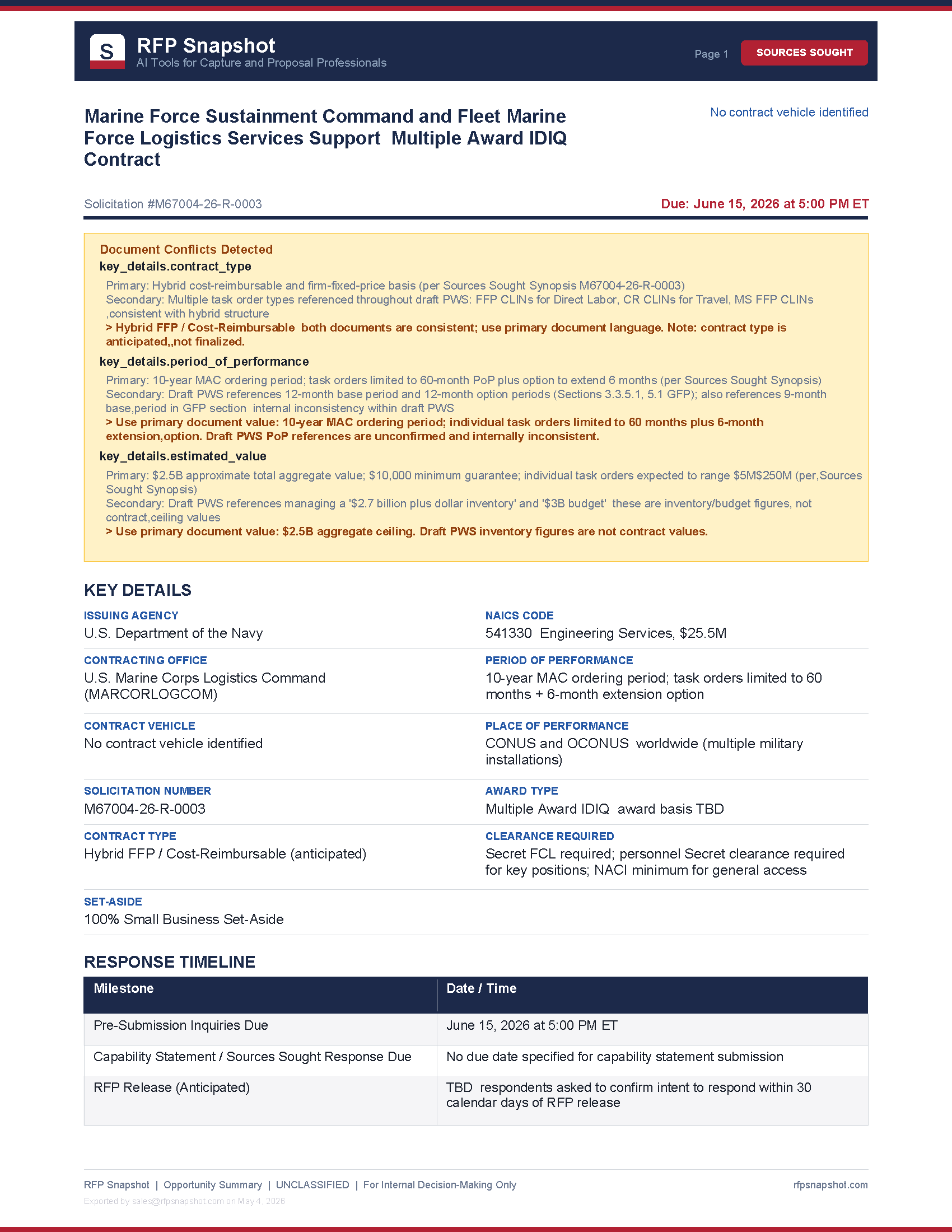
The U.S. Marine Corps Logistics Command (MARCORLOGCOM) posted Sources Sought Synopsis M67004-26-R-0003 for the Marine Force Sustainment Command and Fleet Marine Force Logistics Services Multiple Award IDIQ Contract. The notice describes a 10-year MAC ordering period with an approximate aggregate ceiling of $2.5 billion, set aside 100% for small businesses under NAICS 541330 ($25.5M size standard). Pre-submission inquiries are due June 15, 2026 at 5:00 PM ET. The Government has not yet specified a separate due date for capability statements — respondents should treat the inquiry deadline as the practical floor and confirm directly with the Contracting Officer.
This is one of the larger small-business consolidations the Marine Corps has put on the street in years. The MAC is a follow-on to six existing contracts — SC2, SC7, SCS, DMSS, CSM, and a Class II Program Optimization contract — rolled into a single vehicle that will issue task orders ranging $5M to $250M. If you are a small business with USMC logistics, storage, or distribution past performance, this is the opportunity to read carefully. If you are not, the response window is still long enough to assess teaming with someone who is.
What this MAC actually does — and why six contracts are being consolidated
Marine Force Sustainment Command (MFSC) is the operational hub for USMC ground equipment storage, distribution, and reparable management. Until now, MFSC and its subordinate units have run their support work through six separate contract instruments — each with its own incumbent, its own scope, and its own administrative tail. The new MAC pulls all of it under one roof:
- Section 1 — SC2 (Storage Command Class II Solutions): Operating the Consolidated Storage Program at 21+ locations worldwide. Minimum workforce of 370 personnel, 100% on-site.
- Section 2 — SC7 (Storage Command Class VII Solutions): Force Storage Battalion support at Barstow CA and Albany GA — tactical vehicle maintenance, kitting, pRFID/IUID tagging, Military Equipment movement.
- Section 3 — SCS (Storage Command Business Solutions): MFSC HQ business management, QA, IT (GOCO-IT), audit readiness, and modernization. Explicitly OCI-restricted from competing for SC2 task orders per FAR 9.505.
- Section 4 — DMSS (Distribution Management Support Services): Embedded distribution advocates at aerial and seaports, fleet logistics centers, and MEF locations across CONUS and OCONUS.
- Section 5 — CSM (Coordinated SECREP Management): Reparable Issue Point support across I, II, and III MEFs, MARFORRES, and MARCORLOGCOM. Roughly 33 FTEs.
- Sections 6–9: Initial Issue and Provisioning, Non-Destructive Testing Equipment operations, Care of Supply in Storage, and Material Management Operations Group support.
Practically, this means a single MAC holder can be issued task orders against any of these task areas — subject to OCI mitigation — over a 10-year window. That is a structurally different opportunity than the predecessor contracts, and it changes how a small business should think about positioning.
Read the document conflicts before you do anything else
Page 1 of the Snapshot flags three conflicts between the Sources Sought Synopsis and the draft Master PWS that any capable response has to reconcile. The Sources Sought is the controlling document; the draft PWS is "subject to change." But if you read the draft and act on it without checking what the Sources Sought actually says, you will get the basics wrong. The conflicts:
- Period of performance. Sources Sought: 10-year MAC ordering period; task orders 60 months + 6-month extension. Draft PWS: references 12-month base, 12-month options, and (in another section) a 9-month base. Use the Sources Sought language.
- Estimated value. Sources Sought: ~$2.5B aggregate, $5M–$250M task orders, $10,000 minimum guarantee. Draft PWS: references a "$2.7B inventory" and "$3B budget." Those are inventory/budget figures, not contract ceiling values. Don't quote them in a capability statement.
- Contract type. Hybrid FFP / cost-reimbursable is consistent across both documents but is described as anticipated, not finalized. Plan accordingly — but you will need a DCAA-approved accounting system either way.
This is exactly the kind of cross-document reconciliation that eats hours of a capture analyst's time on a multi-attachment package. We wrote about why this category of work is so expensive when done by hand in The Hidden Cost of Manual RFP Reading.
The staffing picture: 370 minimum on SC2 alone, 30+ key personnel positions across the MAC
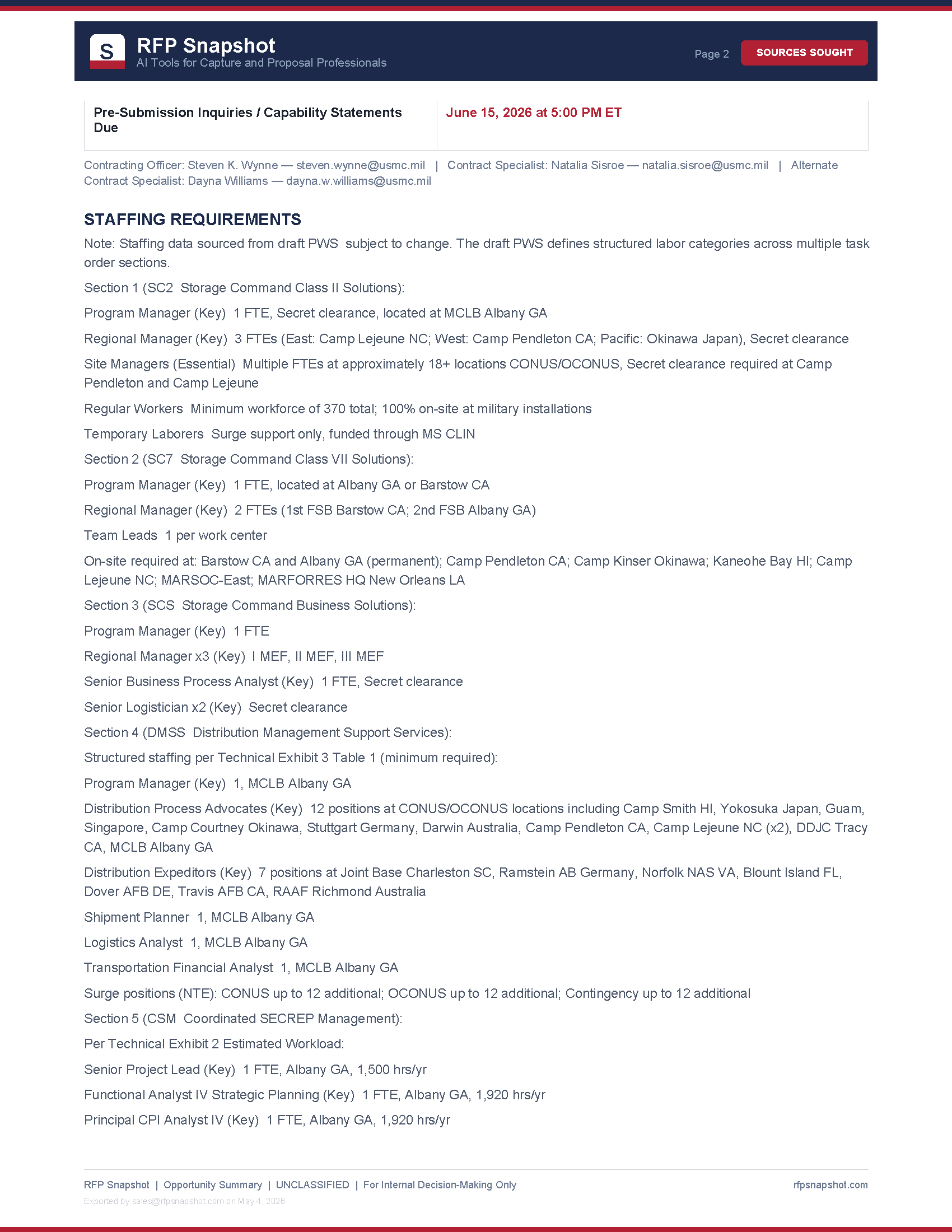
SC2 alone requires a minimum workforce of 370 personnel, 100% on-site at military installations. Add the structured labor categories across SC7, SCS, DMSS, and CSM and the contractor footprint runs across at least 21 U.S. and overseas sites — including Camp Lejeune, Camp Pendleton, MCLB Albany, Camp Pendleton, Okinawa, Kaneohe Bay, Camp Smith, FLC Yokosuka, FLC Guam, FLC Singapore, Stuttgart, Darwin, Joint Base Charleston, Ramstein, Norfolk NAS, Blount Island, Dover AFB, Travis AFB, RAAF Richmond, and DDJC Tracy.
The key personnel inventory is unusually large for a single solicitation. Across the five primary task areas, the draft PWS designates 30+ key positions, the most prominent of which include:
- Five separate Program Manager (Key) positions — one each for SC2, SC7, SCS, DMSS, and CSM — with distinct experience and education thresholds.
- Eight Regional Manager (Key) positions across SC2 (East/West/Pacific), SC7 (1st FSB Barstow, 2nd FSB Albany), and SCS (I MEF, II MEF, III MEF).
- Twelve Distribution Process Advocate (Key) positions (DMSS) at Camp Smith, Yokosuka, Guam, Singapore, Albany, Camp Courtney, Stuttgart, Darwin, Camp Pendleton, Camp Lejeune (x2), and DDJC Tracy.
- Seven Distribution Expeditor (Key) positions (DMSS) requiring Hazardous Declaration of Dangerous Goods certification at Charleston, Ramstein, Norfolk, Blount Island, Dover, Travis, and RAAF Richmond.
- Senior Project Lead, Functional Analyst IV, Principal CPI Analyst IV (Six Sigma Master Black Belt — 5 years held), and four Senior Site Lead Supply Tech positions across the CSM section.
Resumes are required with the proposal for the SCS and CSM key positions, and there are explicit page limits (2 pages per resume) and letter-of-intent requirements. For DMSS, vacancies must be filled within 21 calendar days CONUS / 30 days OCONUS once the contract is active. SC7 and SCS require vacancies filled within 30 calendar days. Several positions specify "no substitution during first 90 days" of performance.
If you are pursuing this MAC, that recruiting load is the work. We've seen capture teams underestimate it consistently — not because the requirements are unclear, but because there are 30+ of them across geographies, clearances, and certification stacks, and the draft PWS scatters the qualifications across multiple sections. This is the exact problem the Recruiter Accelerator add-on solves: it generates publish-ready job postings, salary ranges, and boolean search strings for LinkedIn, Indeed, ClearanceJobs, and Google for every key personnel position in the solicitation, in one pass. For a MAC of this scale, that's the difference between a serious bid and a stack of resumes pulled together in the last 72 hours.
Five things buried in the draft PWS that change the bid math
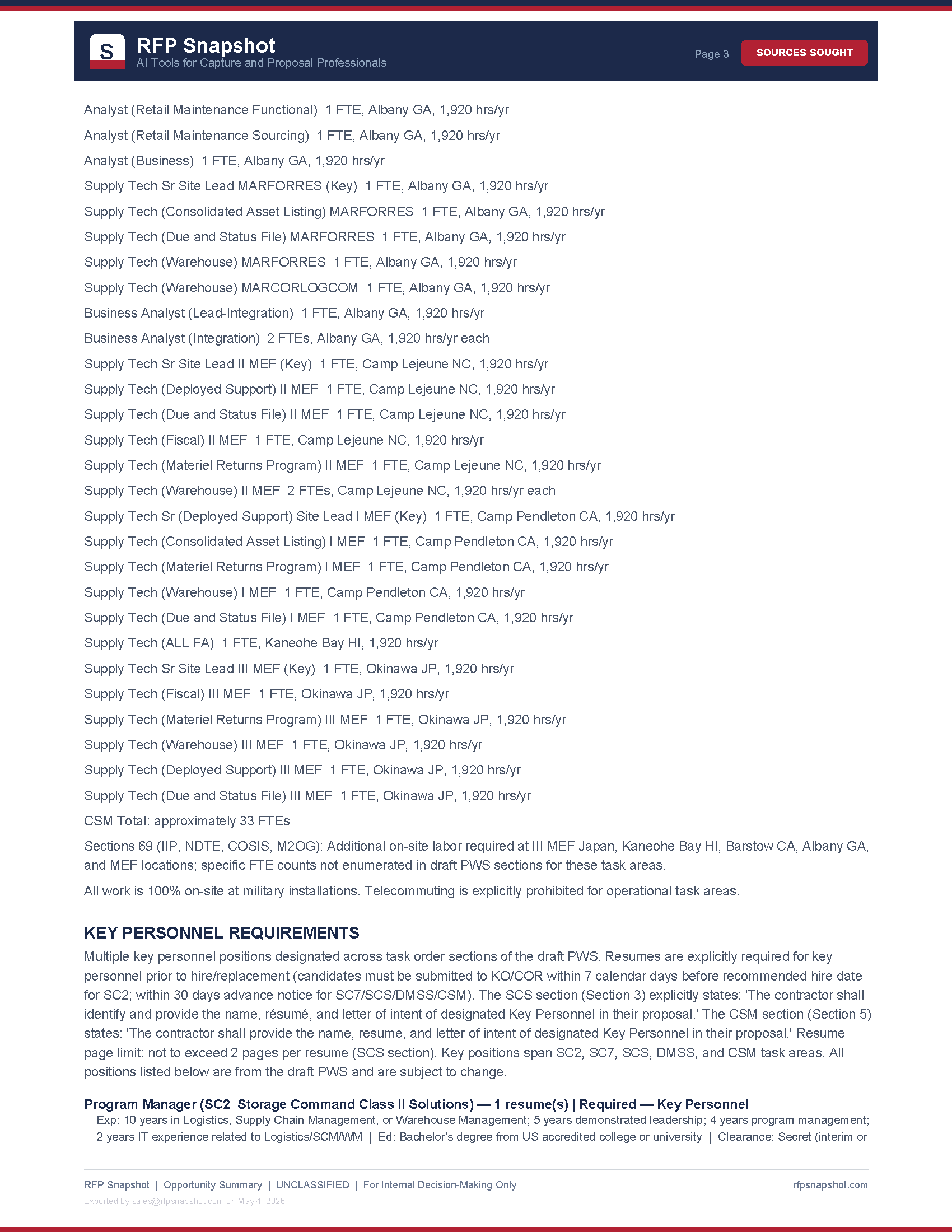
The OCI firewall between SCS and SC2 is real. The draft PWS explicitly states the SCS contractor cannot compete for, or be awarded, SC2 task orders they support, per FAR 9.505 and 9.507. If your firm is already performing SCS-type work for MARCORLOGCOM — or planning to bid SCS — understand that you are voluntarily walking away from SC2 task orders for the life of the MAC. That is a significant strategic decision and it should be made deliberately, not by accident.
DCAA-approved accounting system is a submission requirement. Respondents must explicitly confirm in the Sources Sought response that they maintain a DCAA-approved accounting system and describe their cost-reimbursable execution experience. Firms without one should not respond as primes. This is the single most common disqualifier we see on hybrid FFP / cost-reimbursable opportunities at this scale.
Secret FCL is required at proposal — for multiple sections. SC7, IIP, NDTE, COSIS, M2OG, and DMSS all require the contractor to hold a Secret Facility Clearance Level prior to and throughout performance. SCS requires Secret personal clearances for key personnel. Firms without an active FCL should initiate the process now — sponsorship typically takes 6–12 months and cannot be compressed.
Telecommuting is explicitly prohibited for operational task areas. The draft PWS is unambiguous: SC2, SC7, IIP, NDTE, COSIS, M2OG, and DMSS personnel must work on-site at assigned government installations. Remote work is only authorized during government facility closures, with prior COR/KO approval. If your staffing model assumes any meaningful remote work to widen the labor pool, it doesn't apply here.
30-day intent-to-respond commitment is unusual. The Sources Sought asks respondents to confirm in writing that they intend to submit a formal proposal within 30 calendar days of RFP release. That is an unusual commitment to extract at the market research stage and worth flagging to leadership before you respond. Saying "yes" preserves your seat at the table; the practical implication is that you've signaled the Government you're a real bidder and you should be prepared for a fast RFP turn.
Capability statement structure: keep it tight
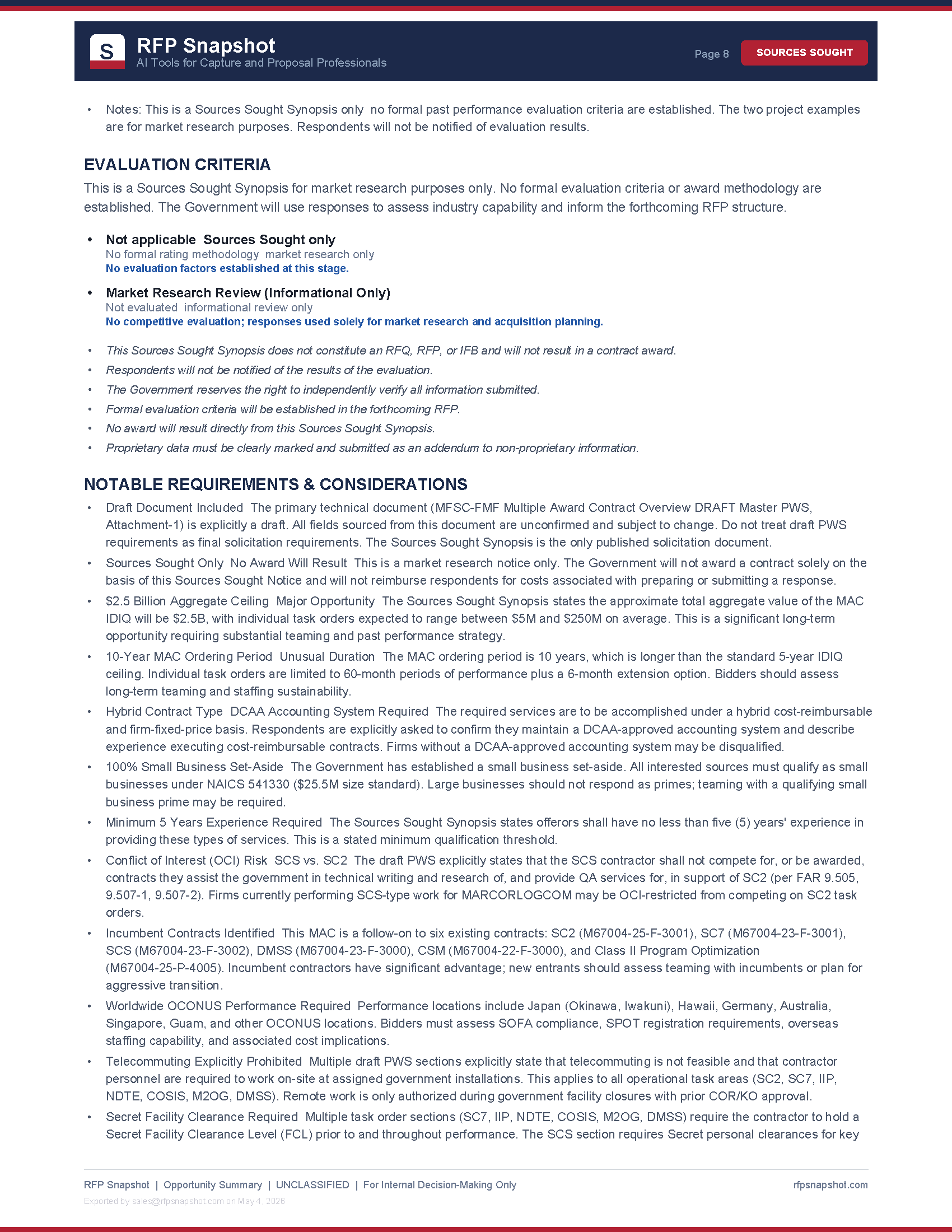
The Sources Sought asks for a structured response with several discrete elements. The relevant experience section is capped at 2 pages; everything else has no stated page limit, but practical capability statements run 8–12 pages. The required elements:
- Company name, CAGE code, UEI, address, point of contact.
- Brief company description and capability statement against the Sources Sought scope.
- Minimum two relevant projects (prime or sub), agency, scope, value.
- Current security clearance level / FCL eligibility.
- Small business size status under NAICS 541330; all socioeconomic certifications; existing contract vehicles applicable to this scope.
- Anticipated teaming arrangements (subcontractors, JVs, partnerships, LLCs) with size status under 541330.
- Confirmation of intent to respond to the RFP within 30 days of release.
- DCAA-approved accounting system confirmation and cost-reimbursable execution experience.
The Government has explicitly noted that a minimum of five years' experience in providing these types of services is required. New entrants without that depth should team with someone who has it. (We covered the mechanics of finding a credible teaming partner in The Government Contractor's Guide to Finding Teaming Partners.)
The incumbent landscape — and where small businesses can actually win
Six predecessor contracts means six incumbents (or incumbent teams) whose past performance is directly relevant. Any of them — assuming they are a small business under 541330 — will be in a strong position to bid the MAC. Some of those incumbents may not be small under 541330, in which case their work transitions to a teaming or subcontracting role rather than a prime bid. USASpending is the right place to start mapping the current landscape: search by the predecessor task order numbers (M67004-25-F-3001, M67004-23-F-3001, M67004-23-F-3002, M67004-23-F-3000, M67004-22-F-3000, M67004-25-P-4005) to identify the actual prime, the obligated dollars, and the period of performance.
For a non-incumbent small business, the realistic paths to win on this MAC are: (1) team with one of the incumbent primes that needs a small-business partner; (2) bid as a prime with a strong incumbent sub on your team; or (3) target the task areas where the incumbent is weakest or has stated capacity constraints. The MAC structure means you do not need to win every task order to make this contract worthwhile — you need to win the right ones.
If you are pursuing: what to do this week
Capability statements have not been given a hard deadline, but the June 15 inquiry deadline is the realistic target for a complete response. That is six weeks of runway for a non-trivial package. The actions that matter most:
- Bid/no-bid against the Snapshot, not the draft PWS. The Sources Sought is the controlling document; treat the draft PWS as a planning aid, not a requirement. Use the Snapshot's document-conflict callouts to avoid the most common mistakes.
- Get a Secret FCL kicked off if you don't have one. Six months is a tight timeline; nine is more realistic. If you can't be cleared by the time the formal RFP drops, you are bidding as a sub, not a prime.
- Map your two relevant experience projects to the right task areas. The Sources Sought asks for two; pick the two that map most directly to the task areas you intend to compete for, not your two largest contracts overall.
- Confirm DCAA accounting system status in writing. If you don't have one, decide now whether to invest in standing one up or pursue this strictly as a sub. The Government will not waive this.
- Start the recruiter pipeline now for the key personnel positions you would need at award. Thirty-plus positions across CONUS and OCONUS with cleared, certified, on-site requirements is a six-month recruiting effort minimum. The Recruiter Accelerator turns the key personnel section of the snapshot into publish-ready job reqs and boolean strings for LinkedIn, ClearanceJobs, Indeed, and Google — built specifically for MACs of this scale.
- If you decide to pursue, line up your kickoff before the formal RFP. The 30-day intent-to-respond commitment means you'll have very little runway between RFP release and proposal due date. The Proposal Kickoff Accelerator generates a kickoff slide deck, compliance matrix, and questions for the Government from the snapshot — so day one of proposal development is actually day one, not day five.
The bottom line for small business pursuers
This MAC consolidates six USMC contracts into a single 10-year, ~$2.5B small-business set-aside vehicle with structured task areas, a 370-person operational floor, an explicit OCI firewall between SCS and SC2, a DCAA-system requirement, a Secret FCL requirement, and a 30+ key personnel inventory across CONUS and OCONUS. It is one of the larger small-business consolidations on the street right now.
If you are a small business with USMC logistics, storage, distribution, or reparable management past performance, this opportunity is worth a serious capture investment. If you are not, it's still worth tracking and worth assessing teaming options. The June 15 inquiry deadline is your forcing function; use it.
We generated a 9-page Opportunity Snapshot from the full sources sought package — including the draft master PWS and supporting attachments. You can download it at rfpsnapshot.com/mfsc-fmf-snapshot — it covers the full task-area scope, key personnel inventory, document conflicts, OCI structure, evaluation language, and notable requirements in a format built for go/no-bid review. For other recent solicitation briefs, see our coverage of SEA 05 Program Support Services and the NPC RAMS recompete.